In modern cricket tournaments, Net Run Rate (NRR) is often the difference between qualification and elimination. One single match can completely boost or destroy a team’s chances.
Have you ever wondered:
“Aaj jeet to gaye, lekin NRR kitna improve hua?”
Or
“Is win enough to jump above another team on the points table?”
That’s where a Single Match NRR Calculator becomes extremely useful.
How One Match Can Change the Entire Tournament NRR
Many fans think NRR changes slowly—but that’s not always true.
A big win or a heavy loss in just one match can:
- Push a team into the top four
- Knock a team out despite equal points
- Decide rankings when points are tied
This is why understanding single match NRR impact is so important, especially during league stages.
The Concept of Match NRR (Simple Explanation)
Match NRR is based on how fast you score runs and how effectively you restrict the opponent.
Two key factors matter:
- Runs Scored & Overs Faced – How quickly your team scores
- Runs Conceded & Overs Bowled – How efficiently your team bowls
The bigger the gap between these two, the better your Net Run Rate.
The Net Run Rate Formula (Simplified)
Here’s the official NRR formula used in cricket tournaments:
While the formula looks simple, manual calculation can be confusing, especially when overs are incomplete or a team gets all-out early.
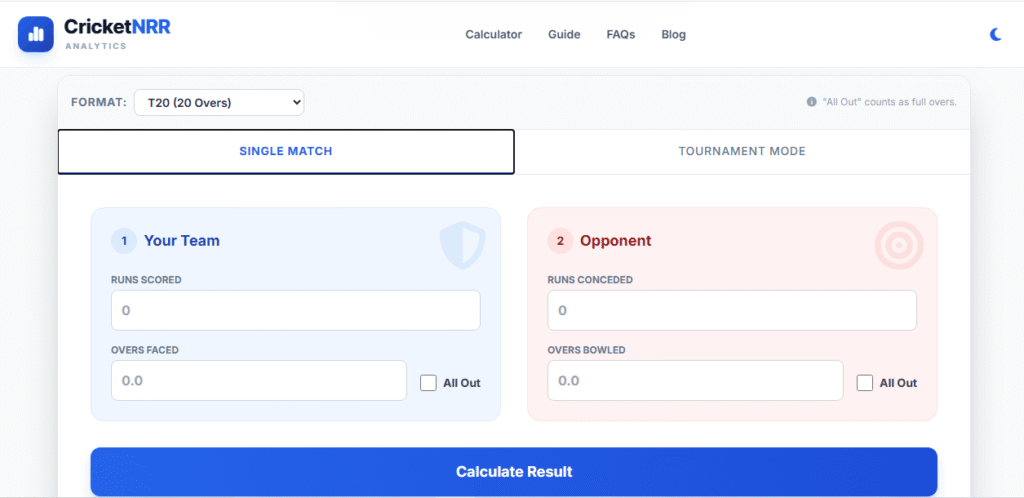
Using the CricketNRR Single Match NRR Tool
The Single Match NRR Calculator on cricketnrr.com makes this process effortless.
Step 1: Enter Runs Scored
Input how many runs your team scored in the match.
Step 2: Enter Overs Faced
Add the exact overs played (for example: 19.4 overs).
Step 3: Enter Runs Conceded
Fill in how many runs the opponent scored.
Step 4: Enter Overs Bowled
Usually the same as overs faced by the opponent.
Important Rule: All-Out Overs Count
If a team gets all-out before completing full overs, the calculator considers the full quota of overs (like 20 overs in T20).
This rule is critical and often misunderstood—but the tool handles it automatically.
Example Scenario: Match NRR Calculation
Let’s say:
- Team A scores: 200 runs in 20 overs
- Team B scores: 150 runs in 20 overs
Calculation:
- Run Rate (Team A) = 200 ÷ 20 = 10.00
- Run Rate (Team B) = 150 ÷ 20 = 7.50
Match NRR = 10.00 − 7.50 = +2.50
That’s a huge positive NRR boost from a single match!
Final Thoughts: Skip Manual Calculations, Use the Tool
Net Run Rate can decide playoffs, semi-finals, and even tournament winners. One small mistake in manual calculation can lead to wrong conclusions.
Instead of guessing or calculating on paper:
- Use the Single Match NRR Calculator
- Get instant, accurate results
- Understand the real impact of every match
Visit cricketnrr.com, try the Single Match NRR tool, and see how one game can change everything 🏆🔥
