In modern cricket, especially in tournaments like the ICC World Cup, IPL, or T20 leagues, one term you hear very often is Net Run Rate (NRR). Many fans get confused when teams qualify or get eliminated based on NRR, even when points are equal.
If you’ve ever wondered what NRR is, how it is calculated, and how tools like NRR calculators work, this complete guide will make everything crystal clear.
What is Net Run Rate (NRR) in Cricket?
Net Run Rate (NRR) is a statistical method used in limited-overs cricket (ODIs and T20s) to rank teams when they have equal points in a tournament table.
In simple terms:
👉 NRR shows how fast a team scores runs compared to how fast it allows the opposition to score.
- If a team scores quickly and restricts opponents → NRR is positive
- If a team scores slowly or concedes quickly → NRR is negative
This is why NRR plays a crucial role in league stages, where teams often finish with the same points.
Why NRR is Important in Cricket Tournaments
NRR is not just a number—it can decide a team’s fate.
- Used as a tie-breaker when points are equal
- Helps determine semi-final or playoff qualification
- Encourages teams to win matches convincingly, not just narrowly
- Impact strategy (teams try to win quickly or restrict runs)
For example, in tournaments like IPL or the World Cup, teams often calculate how many runs they need to win by to improve their NRR.
NRR Formula Explained
The formula for Net Run Rate is:
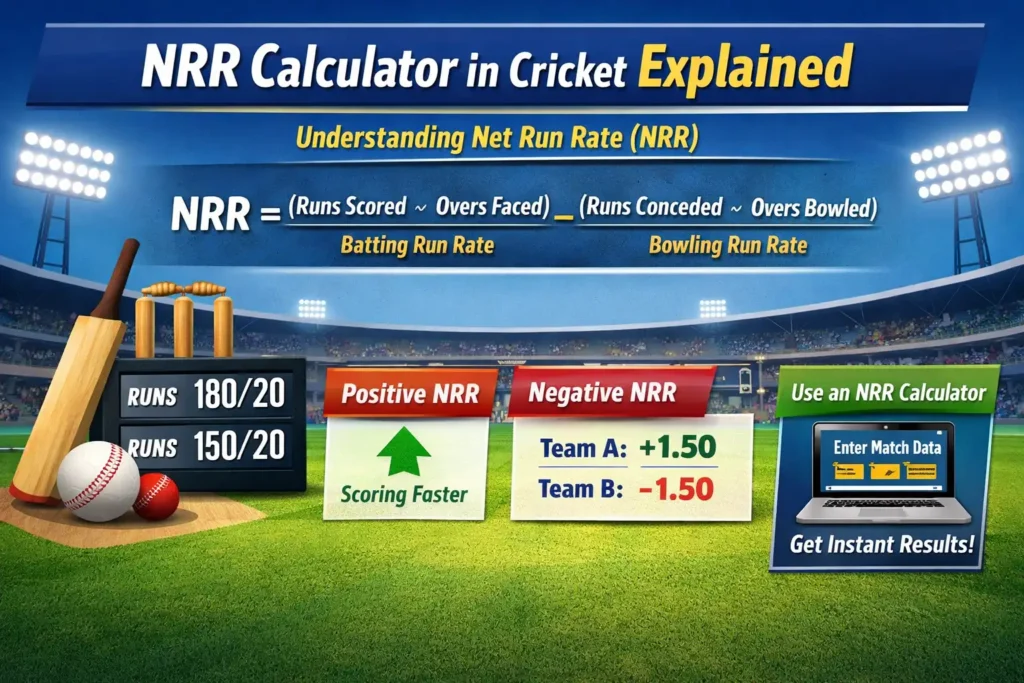
NRR = (Total Runs Scored ÷ Total Overs Faced) – (Total Runs Conceded ÷ Total Overs Bowled)
Let’s break it down:
1. Run Rate (RR)
Run Rate is:
- Runs scored per over
- Example: 200 runs in 20 overs → RR = 10.00
2. Net Run Rate
NRR compares two run rates:
- Your team’s scoring rate
- Opponent’s scoring rate
👉 Final Result = Difference between both
Example of NRR Calculation (Simple)
Let’s understand with an easy example:
Match Scenario:
- Team A: 180 runs in 20 overs
- Team B: 150 runs in 20 overs
Step 1: Calculate Run Rates
- Team A RR = 180 ÷ 20 = 9.00
- Team B RR = 150 ÷ 20 = 7.50
Step 2: Calculate NRR
- NRR = 9.00 – 7.50 = +1.50
👉 Team A has a positive NRR of +1.50
👉 Team B has –1.50
Tournament NRR vs Match NRR
Many people think NRR is calculated match-by-match—but that’s not fully correct.
Match NRR
- Based on a single game
Tournament NRR
- Based on all matches combined
- Uses total runs and total overs across matches
👉 Important: Tournament NRR is not the average of match NRRs
Special Rules in NRR Calculation
NRR calculation has some important rules that many users don’t know:
1. All-Out Scenario
If a team is bowled out early:
- Full overs are still counted
- Example: All out in 15 overs (T20) → counted as 20 overs
2. Chase Completed Early
If a team chases quickly:
- Actual overs faced are counted
- This increases NRR significantly
3. Abandoned Matches
- Not included in NRR calculation
4. DLS Method Matches
- Adjusted scores and overs are used
These rules make manual calculation complicated—that’s why calculators are useful.
What is an NRR Calculator?
An NRR calculator is an online tool that automatically calculates Net Run Rate using match or tournament data.
For example, your website cricketnrr.com allows users to:
- Enter total runs scored
- Enter overs faced
- Enter runs conceded
- Enter overs bowled
👉 And instantly get the NRR result
How NRR Calculator Works
Behind the scenes, an NRR calculator follows these steps:
Step 1: Input Data
- Total Runs Scored
- Total Overs Faced
- Total Runs Conceded
- Total Overs Bowled
Step 2: Convert Overs (Important)
Cricket overs are tricky:
- 19.3 overs ≠ 19.3 (decimal)
- It means 19 overs + 3 balls = 19.5 overs
Step 3: Calculate Run Rates
- Batting RR = Runs ÷ Overs
- Bowling RR = Runs conceded ÷ Overs
Step 4: Final NRR
- NRR = Batting RR – Bowling RR
This automation saves time and avoids calculation errors.
Real-Life Example (Tournament Scenario)
Let’s say a team played 3 matches:
| Match | Runs Scored | Overs Faced | Runs Conceded | Overs Bowled |
|---|---|---|---|---|
| 1 | 180 | 20 | 150 | 20 |
| 2 | 200 | 20 | 190 | 20 |
| 3 | 150 | 20 | 160 | 20 |
Total:
- Runs scored = 530
- Overs faced = 60
- Runs conceded = 500
- Overs bowled = 60
Calculation:
- Batting RR = 530 ÷ 60 = 8.83
- Bowling RR = 500 ÷ 60 = 8.33
👉 NRR = +0.50
How Teams Improve Their NRR
NRR is not random—it can be strategically improved:
1. Win Matches Quickly
- Chase targets in fewer overs
2. Win by Big Margin
- Score more runs than opponents
3. Restrict Opponent
- Bowl tightly and reduce their score
4. Avoid Heavy Losses
- Losing badly damages NRR
This is why teams sometimes play aggressively even when the match is almost won.
Limitations of NRR
While NRR is useful, it has some drawbacks:
- Does not consider wickets lost
- A close match can still produce high NRR
- Can sometimes feel unfair
Example from cricket discussions:
A team may win narrowly but still get high NRR
Why Use an Online NRR Calculator?
Manual calculation of NRR can be confusing due to:
- Overs conversion
- Multiple matches data
- Special rules
That’s where tools like cricketnrr.com help:
Benefits:
- Instant results
- Accurate calculations
- Easy to use
- Useful for fans, analysts, and players
Conclusion
Net Run Rate (NRR) is one of the most important metrics in modern cricket. It not only reflects a team’s performance but can also decide qualification in major tournaments.
To summarize:
- NRR measures scoring speed vs conceding speed
- Positive NRR = better performance
- Used as tie-breaker in tournaments
- Calculated using runs and overs
- Online calculators make it easy and fast
If you regularly follow cricket or analyze matches, using an NRR calculator like cricketnrr.com can save time and give accurate insights instantly.
