In modern cricket tournaments, Net Run Rate (NRR) has evolved from a simple statistic to a decisive factor that can make or break championship dreams. Whether it’s the high-pressure knockout stages of the IPL, the global spectacle of the ICC World Cup, or intense domestic T20 leagues, NRR frequently becomes the ultimate tie-breaker when teams finish with equal points.
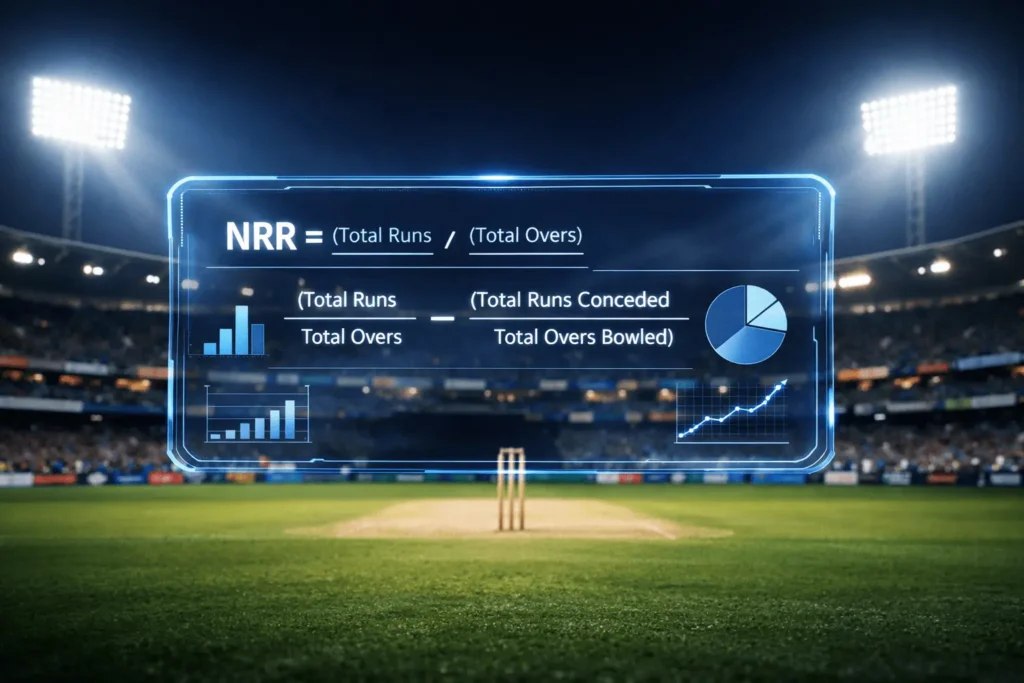
What Is Net Run Rate (NRR)?
Net Run Rate (NRR) is a sophisticated statistical method that measures a team’s overall scoring efficiency relative to its opponents. Unlike traditional averages, NRR provides a dynamic snapshot of a team’s dominance across matches, considering both batting prowess and bowling effectiveness.
The Fundamental Difference: Run Rate vs. Net Run Rate
Many cricket enthusiasts mistakenly use “Run Rate” and “Net Run Rate” interchangeably, but they serve fundamentally different purposes:
- Run Rate (RR): Measures how quickly a team scores runs in isolation
- Formula:
Total Runs Scored ÷ Total Overs Faced - Example: 180 runs in 20 overs = 9.0 RR
- Formula:
- Net Run Rate (NRR): Compares a team’s scoring efficiency against its opponents’
- Formula:
(Team's Scoring Rate) - (Opponents' Scoring Rate Against Them) - Example: Team scores at 9.0, concedes at 7.5 = +1.500 NRR
- Formula:
This distinction explains why teams with identical wins can have dramatically different tournament standings.
The Official Net Run Rate Formula: ICC & Tournament Standards
The universally accepted NRR formula follows this precise calculation:
NRR = (Total Runs Scored ÷ Total Overs Faced) - (Total Runs Conceded ÷ Total Overs Bowled)
Breaking Down the Components:
- Batting Performance:
Total Runs Scored ÷ Total Overs Faced- Measures offensive efficiency
- Higher values indicate aggressive, productive batting
- Bowling Performance:
Total Runs Conceded ÷ Total Overs Bowled- Measures defensive efficiency
- Lower values indicate economical, restrictive bowling
- The Net Result: The difference between these rates
- Positive NRR: Outperforming opponents
- Negative NRR: Underperforming against opponents
Step-by-Step NRR Calculation
Match Scenario:
- Team A: Scores 180/8 in 20 overs, then restricts Team B to 150/9 in 20 overs
- Team B: Concedes 180 runs bowling 20 overs, then scores 150/9 in 20 overs
For Team A:
Batting Run Rate: 180 ÷ 20 = 9.0
Bowling Run Rate: 150 ÷ 20 = 7.5
Final NRR: 9.0 - 7.5 = +1.500
For Team B:
Batting Run Rate: 150 ÷ 20 = 7.5
Bowling Run Rate: 180 ÷ 20 = 9.0
Final NRR: 7.5 - 9.0 = -1.500
✅ Interpretation: Team A dominated by effectively scoring 1.5 runs per over faster than their opponents across the match.
The Crucial “All-Out” Rule: Most Misunderstood NRR Aspect
Official Rule Explained (ICC & IPL Standards)
When a team gets all out before completing its allotted overs, the calculation changes dramatically:
Standard Situation: Team uses all overs → Actual overs faced are counted
All-Out Situation: Team dismissed early → FULL allotted overs are counted
Example (T20 Match):
- Team scores 120 runs but gets all out in 15.2 overs
- Incorrect Calculation: 120 ÷ 15.2 = 7.89 runs per over
- Correct Calculation: 120 ÷ 20 = 6.00 runs per over
Why This Rule Is Essential for Tournament Fairness
- Prevents Strategic Manipulation
- Teams cannot bat slowly, preserve wickets, and still maintain a high run rate
- Encourages positive cricket throughout the innings
- Rewards Dominant Bowling
- Bowling teams get full credit for dismissing opponents quickly
- Early wickets translate directly to NRR advantages
- Ensures Consistent Comparisons
- All teams measured against the same benchmark (full overs)
- Eliminates distortions from different match situations
Rain-Affected Matches & DLS Complications
How NRR Works with Duckworth-Lewis-Stern (DLS) Method
Rain-affected matches introduce additional complexity:
Key Principles:
- Revised targets become official match targets
- Actual overs played (after reduction) become the benchmark
- Super Overs are excluded from all NRR calculations
Example Scenario:
- Original match: 50-over ODI
- Rain reduction: Match becomes 35 overs per side
- Team A scores 210/8 in 35 overs
- Team B’s target: 215 in 35 overs (DLS adjusted)
- Team B scores 200/7 in 35 overs
NRR Calculation Uses:
- 35 overs as the benchmark (not the original 50)
- DLS-adjusted target as the par score
- Actual runs scored in overs played
⚠️ Pro Tip: DLS calculations involve complex mathematical models. Manual calculations often lead to errors in these scenarios.
Positive vs Negative NRR: Tournament Implications
Positive NRR (+): The Qualification Advantage
Characteristics:
- Team scores faster than opponents
- Bowlers restrict opposition effectively
- Indicates balanced, dominant performances
Tournament Impact:
- Primary tie-breaker for equal points
- Can secure playoff spots despite losses
- Psychological advantage over competitors
Real-World Example: In IPL 2023, Mumbai Indians qualified over Rajasthan Royals despite equal points, thanks to superior NRR.
Negative NRR (-): The Qualification Risk
Characteristics:
- Opposition scores faster against the team
- Inefficient batting or expensive bowling
- Often results from one heavy defeat
Tournament Impact:
- Can eliminate teams despite multiple wins
- Difficult to recover after severe negative impact
- Forces aggressive strategies in later matches
Critical Insight: A single catastrophic loss (e.g., losing by 100+ runs) can devastate NRR, requiring multiple dominant victories to recover.
Why NRR Decides Championships: Historical Context
Famous NRR-Decided Qualifications
- IPL 2019: Kolkata Knight Riders missed playoffs despite 12 points, while Sunrisers Hyderabad (also 12 points) qualified with superior NRR
- ICC World Cup 2019: New Zealand reached finals over Pakistan based on NRR despite equal points
- T20 World Cup 2021: Australia advanced over South Africa due to marginally better NRR
Strategic Implications for Teams
Early Tournament:
- Focus on winning, but maintain healthy NRR margins
- Avoid complacency in comfortable chases
Mid-Tournament:
- Monitor NRR relative to competitors
- Adjust strategies based on points table dynamics
Knockout Stage:
- NRR often determines final playoff spots
- Teams may need to chase targets aggressively to boost NRR
Advanced NRR Considerations for Serious Analysts
Tournament-Wide NRR Calculations
For multi-match tournaments, NRR aggregates all performances:
Tournament NRR =
(Total Runs Scored in ALL Matches ÷ Total Overs Faced in ALL Matches)
-
(Total Runs Conceded in ALL Matches ÷ Total Overs Bowled in ALL Matches)
Key Insight: Each match contributes proportionally to the final NRR, making every over in every match potentially decisive.
The Margin of Victory Factor
NRR naturally rewards:
- Large victory margins (winning by many runs)
- Quick chases (winning with many overs remaining)
Strategic Takeaway: Teams aware of NRR implications may:
- Continue aggressive batting despite comfortable leads
- Bowl frontline attackers even in secured victories
- Chase modest targets with maximum urgency
Common NRR Calculation Errors to Avoid
- Using Actual Overs for All-Out Teams
- Error: Counting only overs batted when all out
- Correction: Always use full allotted overs
- Misinterpreting DLS-Adjusted Figures
- Error: Using original targets instead of revised ones
- Correction: Treat DLS figures as official match data
- Incorrect Over Conversions
- Error: 15.3 overs = 15.3 in calculations
- Correction: 15.3 overs = 15.5 (3 balls = 0.5 overs)
- Forgetting Tournament Aggregation
- Error: Averaging match NRRs instead of aggregating runs/overs
- Correction: Sum ALL runs and overs, then calculate
The Evolution of NRR in Cricket History
Pre-1990s: Simple win-loss records determined standings
1990s: Introduction of run rate as initial tie-breaker
2000s: Adoption of Net Run Rate as standard across ICC events
Modern Era: NRR becomes crucial in league formats with multiple equal-point scenarios
Practical Guide: Monitoring Your Team’s NRR
During Tournament Progress
- Calculate After Each Match
- Update cumulative runs scored and conceded
- Update cumulative overs faced and bowled
- Recalculate total NRR
- Compare with Competitors
- Track other teams’ NRR movements
- Anticipate qualification scenarios
- Plan Future Strategies
- Determine required victory margins
- Adjust batting/bowling approaches based on NRR needs
For Fantasy League & Betting Enthusiasts
- NRR as Performance Indicator
- Teams with improving NRR often maintain form
- Drastic NRR changes may indicate team issues
- Qualification Probability Assessments
- Analyze remaining fixtures’ NRR impact potential
- Identify teams needing NRR boosts (may play aggressively)
Conclusion: Mastering Cricket’s Most Important Statistic
Net Run Rate has transformed from a mathematical curiosity to cricket’s ultimate tie-breaker, deciding championships and breaking hearts. Understanding NRR isn’t just for statisticians—it’s essential for:
- Team Strategists: Planning match approaches
- Tournament Organizers: Ensuring fair outcomes
- Fans & Analysts: Predicting qualification scenarios
- Fantasy Players: Making informed decisions
Your NRR Calculation Solution
Manual NRR calculations, especially with all-out scenarios, rain rules, and tournament aggregations, are notoriously error-prone. A single miscalculation can lead to incorrect predictions and missed insights.
Stop risking inaccurate calculations.
👉 Use Our Advanced Cricket NRR Calculator
Our specialized tool automatically handles:
- ICC-compliant all-out calculations
- DLS and rain-affected match adjustments
- Tournament-wide aggregations
- Real-time competitor comparisons
- Historical NRR trend analysis
Get instant, accurate NRR values for any match or tournament scenario—perfect for commentators, analysts, coaches, and passionate fans who need reliable data.
